Pocket / Bag Filters
袋式过滤器 · EN 779 / ISO 16890
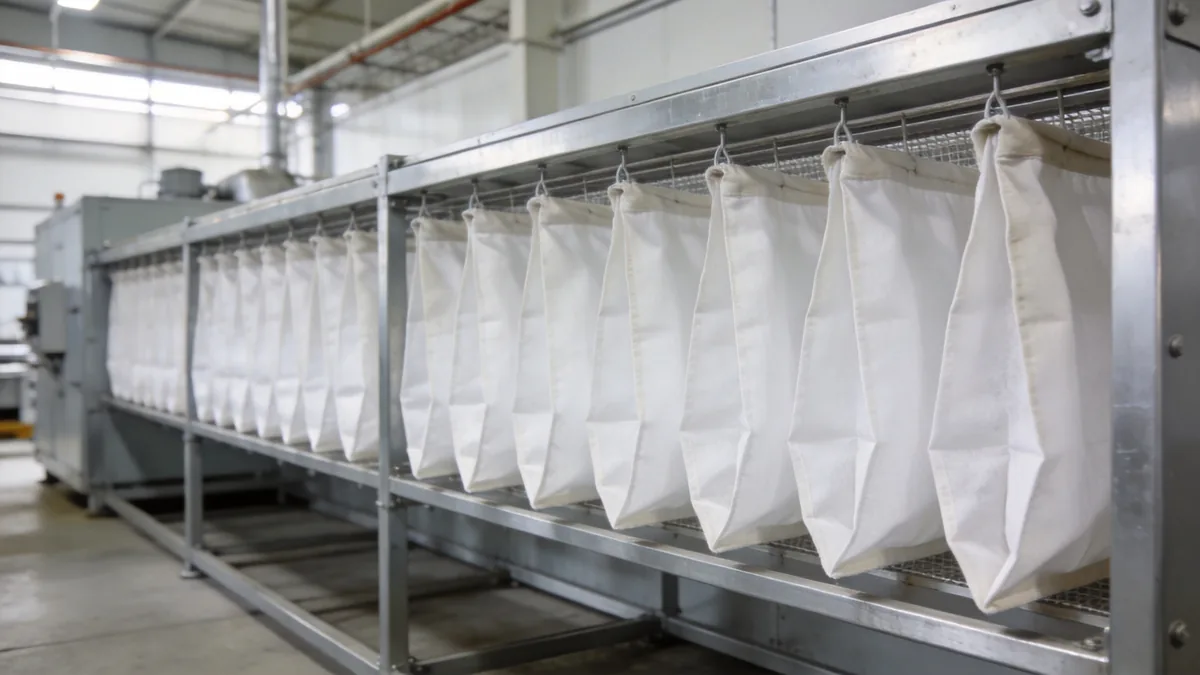
Category at a glance
| Attribute | Value |
|---|---|
| Efficiency framework | EN 779 / ISO 16890 |
| SKUs catalogued | 5 |
| Efficiency grades seen | M5 / M6 / F7 · G4 / F5 · F5 / F7 · M5/M6/F7/F8/F9 |
| Materials / construction | fiberglass · polyester · synthetic_fiber · glass_fiber |
| Application medium | air |
Positioning
Pocket filters provide high dust-holding capacity through extended media pockets, serving AHU main filtration where a compact frame must hold a large media surface area. Bag count and face dimensions are set by the AHU frame.
What it is
Pocket filters provide high dust-holding capacity with a large media surface area in a compact frame for AHU main filtration.
Technical depth
Pocket filters use extended media pockets to maximise surface area and dust capacity. Grades run M5 through F9 (EN 779 / ISO 16890). Media is typically synthetic fibre for strength and long service life, with glass-fibre and polyester variants for specific efficiency and rigidity needs. Frame and pocket-count options vary by airflow, and rigid-pocket forms hold their shape under higher-velocity duty. The number of pockets and the face dimensions are fixed by the AHU frame, so the filter must match the frame rather than the frame matching the filter. High dust-holding capacity is the point of the design: it extends service intervals in main-filtration duty where frequent change-outs are costly. In higher-velocity AHU banks, rigid pockets are preferred because they hold their shape where soft bags would flutter and lose effective area.
Selection guidance
- Match grade to the AHU stage.
- Confirm face dimensions and number of pockets against the AHU frame.
- Request initial pressure-drop and dust-holding capacity for life-cycle cost.
Procurement notes
- Match the grade (M5–F9) to the AHU stage.
- Confirm face dimensions and the number of pockets against the AHU frame.
- Request initial pressure-drop and dust-holding capacity for life-cycle cost comparison.
From a sourcing perspective
Our advice on pocket filters is to fix the frame first and the grade second. Because the face dimensions and pocket count are dictated by the AHU frame, we recommend confirming those against the frame before anything else, then matching the grade to the stage. From a sourcing perspective, dust-holding capacity is the number that matters most here, since it determines service interval and labour cost in main-filtration duty. Request initial pressure-drop and dust-holding capacity for a life-cycle comparison rather than choosing on face price, and specify glass versus synthetic media only where rigidity or a specific efficiency is actually required. Matching the frame first and the grade second is the reliable order of operations here. Dust-holding capacity is the number that matters most, since it sets the service interval and labour cost in main-filtration duty. In higher-velocity AHU banks, rigid pockets are preferred because they hold their shape where soft bags would flutter and lose effective area.
SKUs in this category (5)
Cross-references are discovery aids, not verified fitments.
| SKU | Name | Efficiency | Status |
|---|---|---|---|
AIRY-MERV-POCKET | MERV 5-14 Fiberglass Pocket Air Filter | M5 / M6 / F7 | Catalog confirmed |
AIRY-POLY-POCKET | Polyester Fiber Pocket Filter | G4 / F5 | Catalog confirmed |
AIRY-RIGID-POCKET | Rigid Pocket Filter | F5 / F7 | Catalog confirmed |
KLC-M5-M9-POCKET | M5/M6/F7/F8/F9 Synthetic Fiber Pocket Filter | M5/M6/F7/F8/F9 | Catalog confirmed |
KLC-GLASS-POCKET | Glass Fiber Medium Efficiency Pocket Filter | F5 / F7 | Catalog confirmed |
Per-model dimensions, pressure drop, dust-holding capacity and other unpublished fields are
marked pending in the data subsite
rather than estimated.